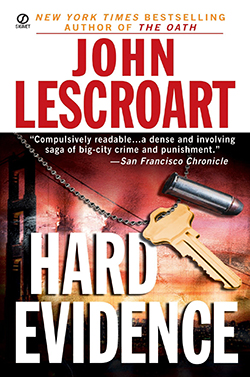
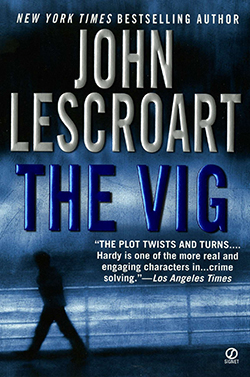
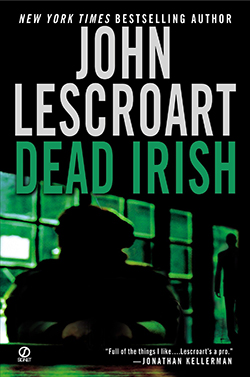
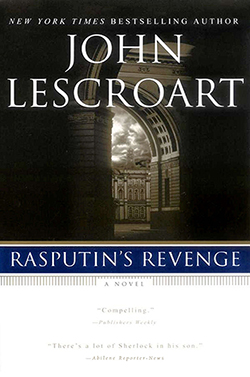
Have you ever wondered where Diz likes to eat? In no particular order, I would consider below the Top Ten San Francisco restaurant favorite haunts of Dismas Hardy.

  1. Sam’s Grill

  2. Original Joe’s

  3. Café des Amis

  4. The Zuni Café

  5. Prospect

  6. Gaspari’s Pizza

  7. Fior d’Italia

  8. A-16

  9. Venticello

  10. Swan Oyster Depot

Of course, no list of Hardy hangouts would be complete with including The Little Shamrock, which is a bar and not a restaurant. But highly recommended all the same.

Enjoy!

Post to Twitter Post to Facebook

{ 0 comments }

Fumblerules of Grammar

January 24, 2012

Those of you following my Matrix for Teaching Writing might be interested in this list of grammatically incorrect grammar rules!

  1. Remember to never split an infinitive.
  2. A preposition is something never to end a sentence with.
  3. The passive voice should never be used.
  4. Avoid run-on sentences they are hard to read.
  5. Don’t use no double negatives.
    See the rest of the list here!

Post to Twitter Post to Facebook

{ 0 comments }

Narrative Voice

From here, our writing matrix moves into a slightly different realm.  While most of the earlier matrix points concerned things to avoid — the passive voice, exposition, redundance, etc. — this next point is neutral, but that does not mean that it’s unimportant.  In fact, it may be the most important decision you make about any writing project you undertake.

Most of us know or should know that there are three possible “voices”:  the first person, where the narrator is “I”; the second person (the least common narrative voice), where the narrator directly addresses the reader as “you”; and the third person, where the narrator uses “he,” “she” or “it.”  All of these can be and have been used to great effect — even, very occasionally, within the same book! Let us discuss them each in turn:

The first person tends to be very immediate, urgent, and personal.  All of these are positives.  Less positive is that in this voice, the point of view is by necessity limited.  When the narrator is “I”, the reader can only become privy to what the narrator has seen or learned him/herself. We always see through the eyes of the narrator and this, of course, is good for hiding secrets that may be just out of the narrator’s view.  It’s not so good at hiding a narrator’s thoughts.  Some of the greatest books ever written have been in the first person.  However, for most beginning writers, the first person is a dangerous choice.  Why is this?  Because there is a natural tendency for inexperienced writers to equate, or at least mix up, the “I” of the narrator with the “I” of the author.  It is essential when telling a story — unless it’s a memoir, of course — to create characters who are real in their own right, and not some thinly disguised amalgam of the author.  So unless you’ve got a very clear idea of your main character as a unique personality, you might find it easier to inhabit that person’s soul by referring to him/her objectively, i.e. in the third person and not the first.

The second person is frankly a bit quirky and sometimes tiring as a literary device.  That said, it was groundbreaking a few decades ago in Jay McInerney’s “Bright Lights, Big City,” and that book spawned more than a few offspring.  In the second person, the author is always talking at the reader.  It has its uses and can be effective, especially in short takes, but again, for the beginning writer, it is slippery to get a hold of and perhaps a bit precious.

The real workhorse for the written word is the third person.  This is the one that can give you objectivity, multiple points of view, clarity in terms of character building and physical description.  It is the lingua franca of a great deal of fiction and almost all non-fiction — again, with the exception of memoir,”gonzo journalism,” cookbooks, etc.  Once you have mastered the third person — no easy feat — I urge you to go on and experiment with the other two options.  But master this one first and you’ll be glad you did.

But whatever voice you’re using, I have an analogy I like to use.  The narrator of a story has to use a clear and pleasing voice that figuratively takes hold of the hand and heart and leads the reader into the story.  The reader should feel comfortable with the vocabulary, the sensibility and the reliability of the author from the very first words.  That is one of the reasons why first sentences are so important — they introduce you the author as the possessor of a voice that we’re going to want to “listen to” during the course of the whole book. You, the author, want that voice to sing, to transport.  It is really in many ways like a singing voice.  And this is why as you start to write, you must give a great deal of thought, energy, and practice to your clarity, your tone, your point of view . . . in short, to your “narrative voice.”

Post to Twitter Post to Facebook

{ 1 comment }

Interview on KQED

January 13, 2012

I was recently interviewed by Rick Klefel for The Agony Column, broadcast on KQED last weekend. You can listen to the interview by clicking here, or download the podcast by clicking here.

You can also read the review on The Agony Column‘s website here.


Post to Twitter Post to Facebook

{ 0 comments }

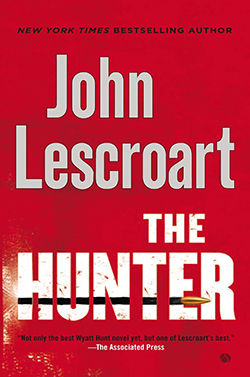
THE HUNTER makes the NY Times Bestseller List!

January 12, 2012

THANKS TO ALL OF MY FANS FOR HELPING TO MAKE “THE HUNTER” MY FIFTEENTH NEW YORK TIMES BESTSELLER. THE HUNTER debuts next Sunday tied for #15 on the NY Times List, and this is against some of the toughest competition I’ve seen in my entire career. You are all the best fans an author could want, and [...]

Read the full article →

The Hunter is available now!

January 3, 2012

THE HUNTER is now available! I’m hoping that you will all help turn THE HUNTER into my 15th New York Times bestseller, and DAMAGE into a paperback bestseller. Both books come out on sale today, January 3, 2012. In order to help you help me make “the list,” I’d like to urge all of you [...]

Read the full article →